Advanced Risk Data Set Features
Assign Consequence

The options listed here are akin to the consequence values available in the Consequence Weighting window. Setting the consequence here notifies in:Flux of what additional values to pull from memory when it updates with the simulation data. Most commonly this is used for risk-based gas detector mapping, so defaults are set to values which may be used for that purpose, however other consequence assignments can be set. Follow the hyperlink above for more information about the various options.
Set Maximum Risk Data Set Size
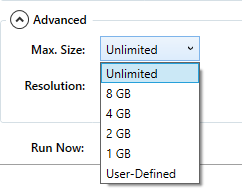
For some projects, risk data sets may be several gigabytes in size. This can be due to a number of factors, but generally the larger the domain of the risk data set, the more information needs to be stored. Prior to defining the risk data set you can use this Max Size option to set a limit on how large (in memory) the risk data set can get. This can be helpful in reducing total file size, as well as speeding up workflow. The reduction removes less important mesh cells, while retaining data quality.
This process can also be done after the risk data set is created, shown below.
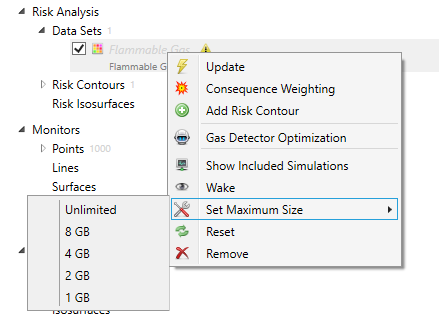
At any time, you can view the current size of the risk data set by selecting its name in the Project Items Tab and looking at the Current Data Size listing in the properties panel.
Set Resolution of Risk Data Set Variable
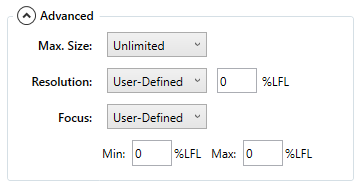
Although for most all cases the resolution is automatically applied, it may be the case that you want to explicitly tell in:Flux the values you are looking at. The resolution setting shown above tells in:Flux when it should increase the resolution of the grid making up the risk data set, i.e. enter a value of 1% LFL here would tell in:Flux to add grid cells in the risk data set when there is greater than 1%LFL difference between two grid cells. It is advised to leave this as the automatic option as changing the resolution can increase the risk data set size.
Focus is telling in:Flux when to apply the resolution. For example, if you are looking at gas detector alarm setting of 25%LFL, one could enter a Min value of 20% LFL and a Max value of 30%LFL while setting the resolution to a User-Defined 1%LFL. Doing this will tell in:Flux to apply the resolution condition if the LFL values are between 25-30%.
Time Option for Transient Simulations
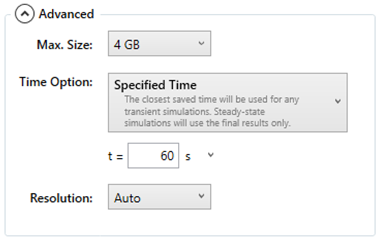
A risk data set can include both steady-state and transient simulations among its constituent cases. Steady-state simulations have a single result per variable, but transient simulations have a time history - so when the risk data set aggregates data across simulations, in:Flux needs to know which time point to pull from each transient simulation.
The Time Option, located on the Advanced tab when creating a risk data set, controls this. Two choices are available:
-
Final - the last timestep of each transient simulation is used. This is the default and is appropriate when the transient simulation has been run long enough to reach its representative state (for example, a dispersion that has reached steady conditions after an initial release, or a fire that has stabilized).
-
Specified Time - the user enters a value of t, and in:Flux samples each transient simulation at the closest saved time to t. Useful when the analysis is about a specific moment in the scenario (for example, assessing conditions 60 seconds after ignition or 30 seconds after ESD initiation).
Steady-state simulations in the same risk data set are unaffected by the Time Option - they continue to use their final results regardless of the setting.
Maximum Footprint Type for Contours and Isosurfaces
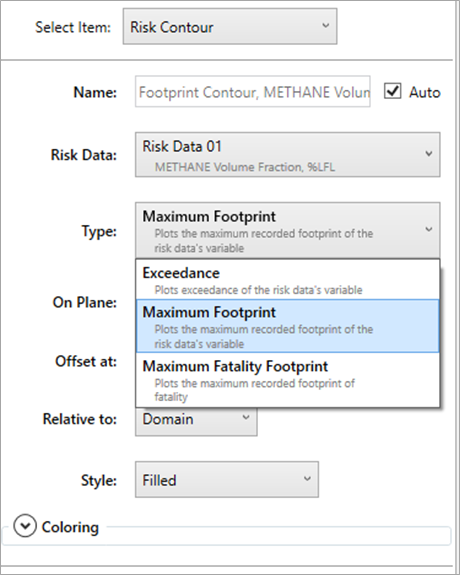
Risk contours and risk isosurfaces normally display a risk-weighted value based on the risk data set's variable. The Maximum Footprint type, available as of version 4.0, instead plots the maximum recorded footprint of the variable across all simulated scenarios in the risk data set.
This is useful when the question is not "what is the probability-weighted level at each point?" but "across every credible scenario in this study, where did this variable ever exceed a given level?". The result is a worst-case spatial envelope. Common uses:
-
Maximum extent of a flammable gas cloud (variable = %LFL)
-
Maximum thermal radiation footprint (variable = incident radiation, for fire risk data sets)
-
Maximum toxic concentration envelope (variable = concentration of a toxic component)
The setting is made when the visual is defined, not afterwards on the property grid. When you define a risk contour or a risk isosurface, the panel includes a Type dropdown with three options:
-
Exceedance - default value used normally for risk contours and risk isosurfaces, such as in Tutorial 11.
-
Maximum Footprint — plots the maximum recorded footprint of the risk data's variable
-
Maximum Fatality Footprint — plots the maximum recorded footprint of fatality
Choosing Maximum Fatality Footprint reveals an additional Exposure time field, entered in hours, minutes and seconds. See also: Probits and Fatality Assessments for that type, which is a specialization of this feature for risk data sets tracking a dose variable.
It is rare to need to set the maximum size or the resolution of risk data sets, however you may always email us at info@insightnumerics.com with any questions regarding risk data sets or other features.