Smoke Visibility Variables
The thermal load from a fire is only one of the consequences relevant to personnel exposure. Smoke produced by the fire reduces visibility, hindering both escape and emergency response. The visibility distance through a smoke layer depends on the soot concentration in that layer and on whether the object being looked for emits its own light (such as an exit sign) or only reflects ambient light (such as a doorway). As of version 4.2, in:Flux fire simulations compute smoke visibility for both object types, derived from the standard correlation in the SFPE Handbook of Fire Protection Engineering.
The Visibility Correlation
The visibility distance S through a smoke layer is given by:
S = K / (Km · Cs)
where:
-
K is a dimensionless object constant - approximately 8 for light-emitting signs and approximately 3 for light-reflecting signs (per the SFPE Handbook).
-
Km is the specific extinction coefficient. in:Flux uses the widely accepted value of 8.7 m2/g (8700 m2/kg) for flaming fires, established by Mulholland and Croarkin and also used in standard fire models such as FDS and CFAST.
-
Cs is the soot mass concentration (mass of soot per unit volume of air), computed by the simulation.
Two smoke visibility values are produced - one for light-emitting objects (using the larger K) and one for light-reflecting objects (using the smaller K). Visibility distance for light-emitting objects is roughly 2.7 times that for light-reflecting objects in the same smoke conditions, reflecting the difference in how each is detected against the smoke background.
Where Smoke Visibility Appears
Smoke visibility is available wherever a variable can be selected for a fire simulation:
-
Monitor points, lines, regions, and surfaces
-
Contour visualizations
-
Isosurfaces (for example, the envelope where visibility falls below a threshold such as 10 m), shown below
-
Risk-based outputs derived from fire simulations
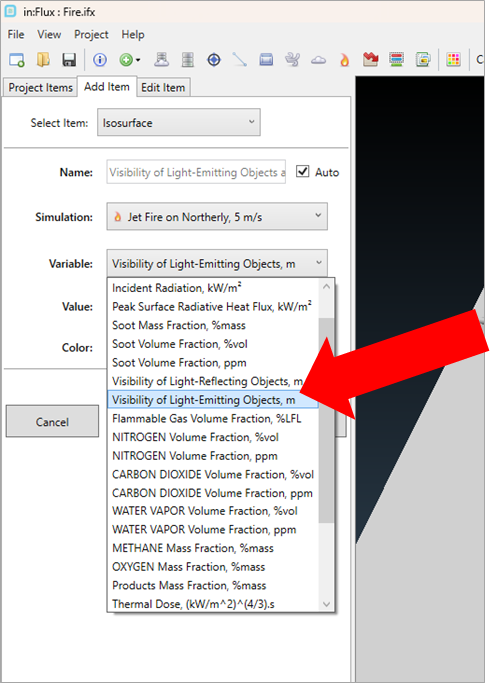
Smoke visibility is only available for fire simulations, since the calculation requires a soot concentration field, which is only computed when combustion is being modeled.
Typical Threshold Values
-
Visibility > 10 m - generally accepted as the threshold below which evacuation from large or unfamiliar spaces becomes significantly impaired.
-
Visibility > 3-5 m - the threshold often used for small or familiar spaces where occupants can rely on touch and prior knowledge of the layout.
-
Project-specific thresholds should follow the basis-of-design or the applicable performance standard.
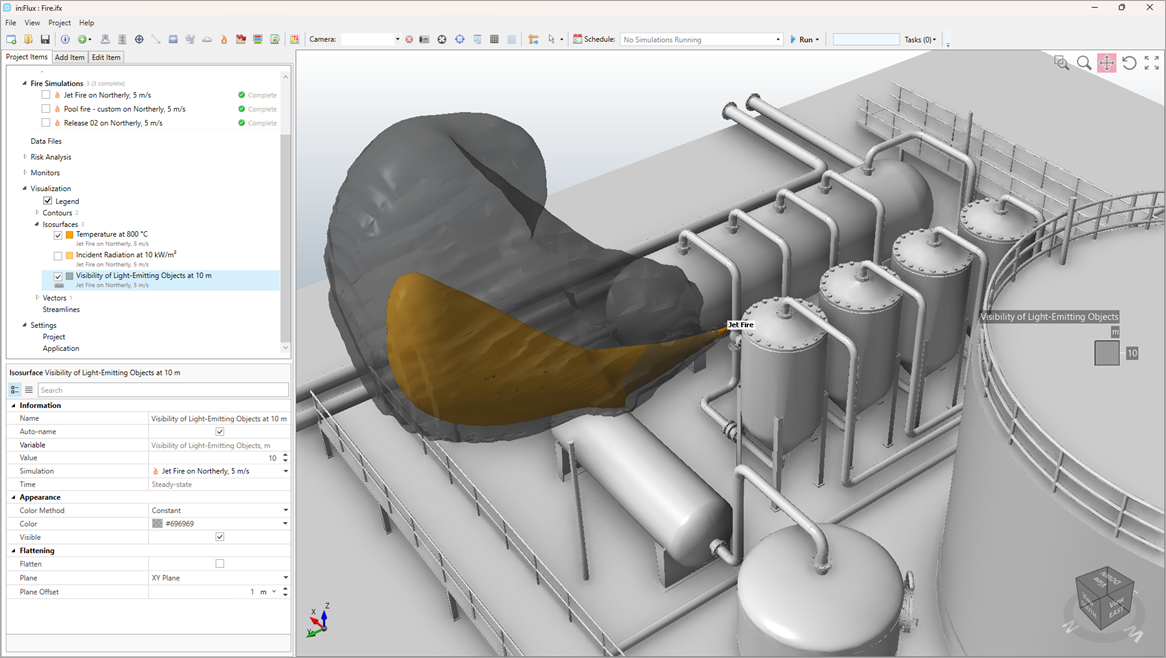
Display of the Visibility of Light-Emitting Objects at 10m variable as an isosurface for an example jet fire
When to Use Smoke Visibility
-
Escape route analysis - check whether visibility along the egress path remains above the threshold for the time required to evacuate.
-
Emergency response analysis - assess whether responders entering an area can locate equipment, valves, or personnel.
-
Sign placement - verify that exit signs and other safety markings will remain visible at the design distance under credible smoke conditions.
-
Smoke control system design - quantify the benefit of smoke extraction on visibility along key routes.
Scope and Limitations
-
The visibility correlation is statistical and based on standard assumptions about ambient light, object contrast, and observer eye condition. Project-specific conditions (low ambient light, smoke-affected eyes, irritant gas exposure) reduce real visibility below the predicted value. The correlation is a starting point for engineering judgment, not a precise prediction.
-
Soot yield depends on fuel and combustion conditions. The simulation result is only as accurate as the soot yield assumed for the fuel; verify against representative test data or published values for the fuel in question.
-
in:Flux uses a single typical Km regardless of fuel. Because the extinction coefficient is in principle weakly fuel-dependent, visibility predictions for fuels whose smoke has significantly different optical properties may be approximate.
-
The 8.7 m2/g extinction coefficient applies to flaming fires. Smouldering fires produce optically different smoke and require a different coefficient if assessed via CFD.
See also: Tutorial 15 - Single Jet Fire, Tutorial 17 - Transient Fire Simulations, Tutorial 18 - Pool Fires.
References:
-
Society of Fire Protection Engineers, SFPE Handbook of Fire Protection Engineering, 5th edition, Springer (2016) - chapter on Visibility.
-
Mulholland, G. W. and Croarkin, C., "Specific Extinction Coefficient of Flame Generated Smoke," Fire and Materials, vol. 24 (2000) - established Km = 8.7 m2/g for flaming fires.